Tuesday, September 30, 2014

Monday, September 29, 2014
Day Seventeen
Today in class, we met in Mrs. Smith's room and read the Human Geo blog. We watched a video about the growth and decrease in population and answered questions about the video. The video taught me about population pyramids in different countries. All the countries have different populations in the age ranges, and depends on what age. United States has the most people in the in age range of 50-65, because of the baby boom. In years to come, this population pyramid might change, and I can;t wait wait to see what this leads to!
Saturday, September 27, 2014
Day Fifteen
In class, we talked about the CIA world fact book. Two students showed us interesting fact about the USA, Antarctica, and Canada. We learned more about different countries like Lebanon and Chad. I looked up images on Google, to see what these countries looked like, and saw that some were beautiful. Others like Chad, were poor and not attractive. We also talked about nuclear bombs and how to protect us if there was one. We watched a video about "Duck and Cover", which showed people duck and covering when the town sirens go off, if there is a nuclear bomb. I think this should be practiced more in schools, for our safe.
Wednesday, September 24, 2014
Monday, September 22, 2014
Day Thirteen
Today in class, we went over more of the population and settlement power point. We learned about poatabal water and how some countries don't have fresh water. We learned a lot more about life expectancy. Life expectancy is the average number of years to be lived by a group of people born in the same year. Each country has a different life expectancy, to see how old others live to be. We learned about infinite morality and how children don't live to their 1st birthday. The power point talked about measuring population. The crude birth rate is the number of births per 1,000 of the population. The crude death rate is the number of deaths per 1,000 of the population. We compare countries per 1,000. The rate of natural increase is found by subtracting the death rate from the birth rate. This gives us the annual natural growth rate in percentage form for a country or region. The net migration rate is the difference between the number of persons entering and leaving a country during a year. The excess of persons entering the country is net migration.
Friday, September 19, 2014
Day Twelve
Today in class, you showed us a power point on population and settlement. We learned that 90% of this population growth takes place in the developing countries of Africa, South and East Asia, and Latin America. We also learned that there are over seven billion people on the planet right now. In 1804, the population was only one billion people, but grew to be seven. It took 10,000 years to get the population to 1,000 more people. Only 50 years ago there was a lot less of a population then now. This growth over time is crazy, and I can't wait to see the population when I'm older, in the future.
Wednesday, September 17, 2014
Day Eleven
Today in class, we took the test. I felt very good about the test, as I got a good grade. The only question that I was stuck on was "When was the Message to Garcia written?" and put the best answer I could. Other than that question, I felt prepared for this test. The questions were everything I studied, and I was very happy with the outcome. Hopefully, I did well on this test, so it does not effect my grade.
Tuesday, September 16, 2014
Day Ten
Today in class, we studied for our test tomorrow. We had a substitute, and worked in groups to make flashcards on quizlet.com. I worked with Meredith and Leigh, and we quizzed each other. We seemed to get most answers correct, and felt prepared. The questions we wrote down were about everything we learned about in class. Example is "Who wrote Message to Garcia?" and we would say Elbert Hubbard. I feel that I a prepared for this test, and will get a good grade.
Monday, September 15, 2014
Friday, September 12, 2014
Day Eight
Today in class, we talked about globalization. Globalization is the connection of different parts of the world, which is referred to as interconnectenis. Globalization results in the expansion of international, cultural, economic, and political activities. Globalization is often associated with "Americanization." We learned about the Silk Road and how China made silk for trade with other countries. The Silk Road connected markets of Asia, Arabia, Mediterranean, and Eastern Africa. China didn't just make silk, but also tea. We also learned about Japan and the increase of fast food restaurants, which includes McDonald's, KFC, and many more. This effects the life expectancy of the Japanese.
Wednesday, September 10, 2014
Day Seven
Today in class, we started talking about our blogs from last night. We all shared our thoughts and feelings toward the "Did You Know?" video. Everyone learned a lot from the video, and it was very surprising. Later on in the conversation, we talked a lot about trading. Trading took place a long time ago, and still takes place today. We trade with different countries for several many things. Some traders do not speak English and the most common word is "okay." We thought about the trading and started looking at our clothes, shoes, books, and more, to see where they were from. I was shocked at how crazy it is, that a lot of our stuff comes from so far.
Tuesday, September 9, 2014
Day Seven
I left class early today, but I can still do the blog with the video attached. This video was very surprising about the technology in different countries. I didn't know all these facts, and it was very interesting. This effects my personal life a lot. Instead of worrying about technology, you can look up for once and enjoy the time you have. Technology ruins everyone's lives, it is so addicting in this time period. People can't do anything without their cell phone in their hands, or some sort of technology device. This is a problem for people to focus and be aware of things. Technology plays a part in my life, by using laptops at jc and having a cell phone.
Friday, September 5, 2014
Day Six
agora- an open space that served as a meeting ground for various activities such as artistic and athletic, spiritual, and political life of the city
http://www.britannica.com/EBchecked/topic/9404/agora
http://www.britannica.com/EBchecked/topic/9404/agora
arete- means excellence of any kind and moral virtue or the act of living up to ones full potential
http://randalvegter.com/what-is-arete/
http://randalvegter.com/what-is-arete/
polis- ancient Greek city-state and it was centred on one town central urban area, a body of citizens http://www.britannica.com/EBchecked/topic/467403/polis
the year of 508 BC- the year of the pre-Julian Roman calendar, it was known as the "Year of Consulship of Poplicola and Triciptitinus" birth of democracy
http://en.wikipedia.org/wiki/508_BC
socrates- classical Greek philosopher who is credited with laying the fundamentals of modern Western philosophy
http://en.wikipedia.org/wiki/508_BC
socrates- classical Greek philosopher who is credited with laying the fundamentals of modern Western philosophy
http://www.ancientgreece.com/s/People/Socrates/
the death of socrates- 1787 oil painting by Jacques-Louis David and Socrates died from corrupting the youth of athens, dissing the Gods, and death by hemlock
http://en.wikipedia.org/wiki/The_Death_of_Socrates
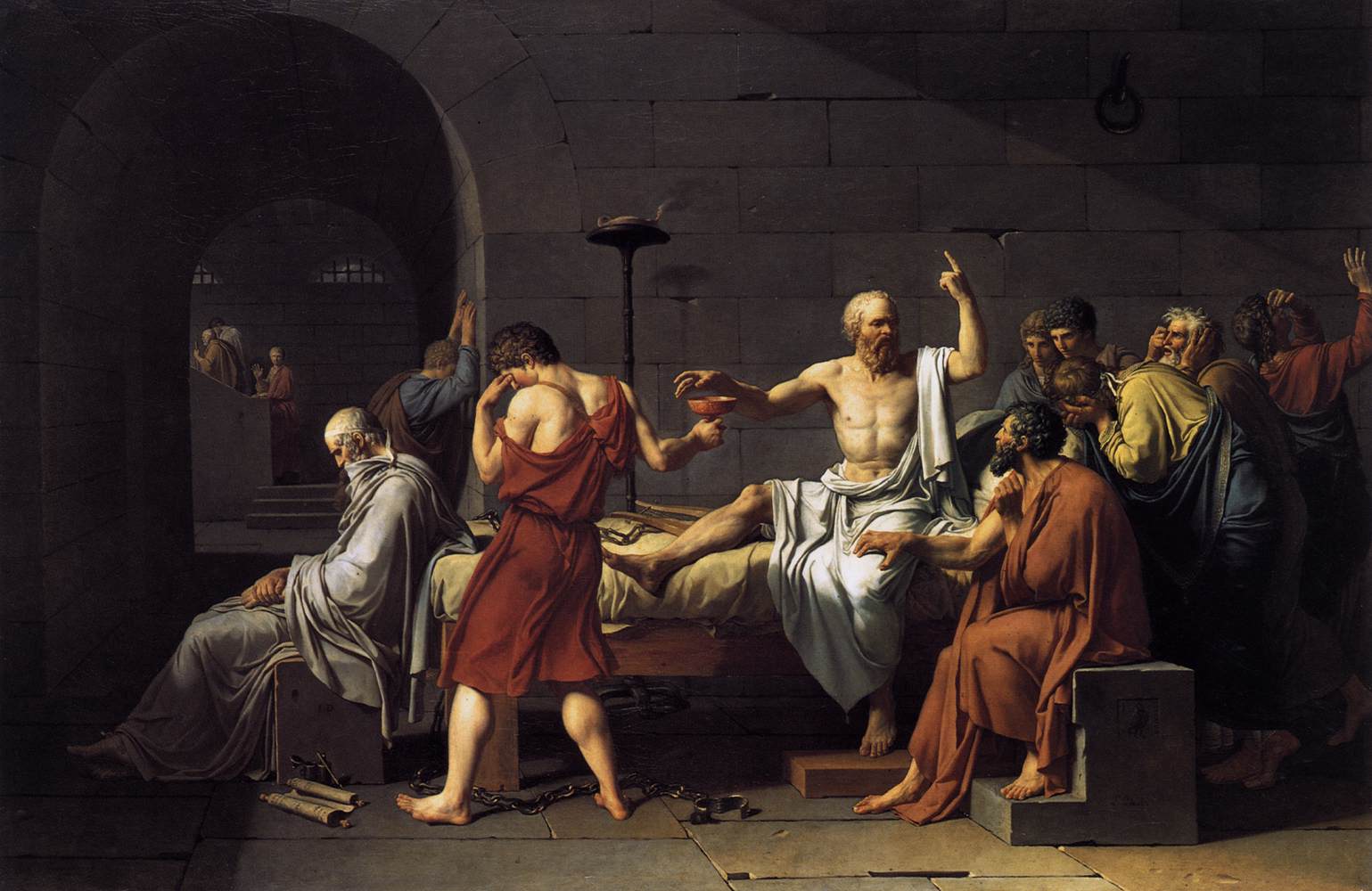
the socratic method- socrates created and it is a form of inquiry and discussion between individuals, based on asking and answering questions to stimulate critical thinking and to illuminate ideas
http://en.wikipedia.org/wiki/Socratic_method
what ancient greeks meant if they called you an idiot- "person lacking professional skill" or a private citizen/individual
http://en.wikipedia.org/wiki/Idiot
http://en.wikipedia.org/wiki/The_Death_of_Socrates
the socratic method- socrates created and it is a form of inquiry and discussion between individuals, based on asking and answering questions to stimulate critical thinking and to illuminate ideas
http://en.wikipedia.org/wiki/Socratic_method
what ancient greeks meant if they called you an idiot- "person lacking professional skill" or a private citizen/individual
http://en.wikipedia.org/wiki/Idiot
Wednesday, September 3, 2014
Day Five
Today in class, we talked about the story we read in class called "A message to Garcia". The story was in the newspaper, and so many people wanted their own copy, so they made booklets of it. They sold 80 million copies of the story, for people to learn and read. We learned about the author, Elbert Hubbard. Elbert died on a ship called RMS Lusitania, in 1915. After we talked about the story, we talked about the age to vote and politics.We talked about how mostly the people that vote are older, because they really care about our country, even if they are dying soon. Back then, you couldn't vote until you were 21, but they have now changed it to 18. You could risk your life to go in the army, but couldn't vote.
Tuesday, September 2, 2014
Day Four
Today in class, we talked about how to set up our blogs. A lot of people in our class were making new blogs, instead of adding to the ordinal blog. I was confused at first, but then understood what we had to do to add to our blog. The title for our blogs were wrong, so we also changed that. We learned how to check power school, to see our grade in the class. If you don't complete a blog, he will take points off. On the human geo blog, we watched a video of the ALS ice bucket challenge. ALS is a very serious disease and we have raised over 90 million dollars. Doing the ice bucket challenge and donating money can make a big difference. We were challenged to do the challenge for a good cause.
Second Day
Today in human geography class , we made sure everyone had or knew we had to have a copybook for the class. The copybook is good to have to write down notes and to better understand what you are writing . Mr. Schick went over what to do when we are absent, so we are prepared. When we have athletic games or have to leave early we have to tell him before, so he will know you have to leave. When we need to see or need help from Mr. Schick, you have to meet him at his office when you both are free. Mr. Schick teaches in three different classrooms, so it might get confusing. He gave us our daily homework, which is to write our blog. After that he dismissed us and we went to our other classes . Can't wait what we do in human geography in the future !
Monday, September 1, 2014
Day Three
This year I will do several things to help me have a successful year at John Carroll. One of those things will be to be organized. Being organized will help because then I wont get anything mixed up for this class. It will ensure me that I will never have a paper missing. Another way will be to be kind to everyone so that I don't have any drama my freshman year. It will also help me because it will help me make new friends. My third way of being successful this year is going to be a good student, by always doing my homework. This will help me get a good grade in your class. Another thing is going to be always use my off mods wisely. I will work on things that need to be completed. Another way is that I will show up on time with time to spare in class so that I have time to get situated for my class.
Subscribe to:
Posts (Atom)